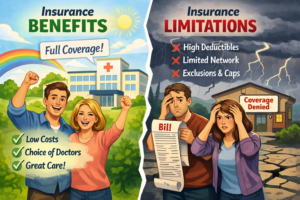
Comparing the promised benefits and real limitations of short-term insurance
I. Introduction — The Promise vs Reality
When I first heard about short-term health insurance, the promises sounded perfect: quick enrollment, lower premiums, flexible terms. I imagined it would be a smooth, temporary safety net while I transitioned between jobs.
Reality hit hard. What seemed like a simple solution turned into a series of confusing choices, frustrating denials, and unexpected costs. I spent hours reading policy documents, tracking deadlines, and learning to decode the fine print.
This article is my personal account of exploring benefits, enrollment errors, renewal struggles, pre-existing conditions, and hidden costs, along with the lessons I learned and how I eventually gained control over my coverage.
II. Evaluating Benefits vs Limitations
Initially, I assumed the benefits listed on short-term insurance charts were meaningful. In reality, coverage limits and exclusions often made some benefits useless.
I created a visual comparison chart to help me analyze what I was really getting:
| Benefit Type | Promised Coverage | Realistic Coverage | Personal Experience |
|---|---|---|---|
| Doctor Visits | Unlimited | Max $500/year | Hit cap in 2 visits |
| Prescription Drugs | Covered | Only generic, max $200/year | Paid out-of-pocket for brand meds |
| Specialist Visits | Covered | Excluded if pre-existing | Denied claim for dermatology |
| Emergency Room | Covered | $2500 deductible | Paid $1500 upfront |
| Dental | $50/year | $50/year | Practically useless |
Seeing the gap between promised vs realistic benefits was my first eye-opener.
III. Enrollment Mistakes — My Costly Errors
I thought enrollment would be a straightforward online form. Wrong. I encountered:
-
Misreading questions about past coverage, leading to rejections
-
Overlooking deadlines, which caused gaps
-
Submitting incomplete documents, resulting in delays
Lesson learned: always double-check forms, mark deadlines, and keep copies of every submission.
Here’s a visual checklist I created for enrollment:
Following this checklist eventually saved me from multiple coverage gaps.
IV. Renewal & Extension Struggles
Short-term plans often don’t renew automatically. Missing the small renewal window can mean higher premiums or total denial.
I used a timeline visualization to manage my renewals:
Tracking everything visually helped me avoid gaps, and I recommend all users do the same.
V. Pre-Existing Conditions — The Hard Truth
I have a mild chronic condition, and it was excluded by most providers. One insurer refused any claim related to my condition.
I realized that if you have ongoing health needs:
-
ACA plans may be safer
-
Short-term plans are only for temporary gaps
I even created a decision matrix to decide which plan to pick:
| Condition | Short-Term Plan Suitability | ACA Plan Suitability |
|---|---|---|
| Chronic Condition | ❌ Poor | ✅ Good |
| Temporary Gap | ✅ Good | ✅ Good |
| Budget-Conscious | ✅ Good | ❌ Expensive |
| Minimal Medical Needs | ✅ Good | ✅ Good |
This helped me choose wisely, avoiding costly claims denials.
VI. Hidden Costs — A Painful Lesson
The monthly premium looked cheap — but deductibles, copays, and out-of-pocket maxes quickly added up.
I kept a cost tracker table:
| Expense | Amount Paid | Expected vs Actual |
|---|---|---|
| Doctor Visit | $250 | $50 expected |
| Prescription | $120 | $20 expected |
| ER Visit | $1500 | $500 expected |
| Total | $1870 | $570 expected |
Hidden costs were shocking. Visualizing them helped me plan and budget more effectively.
VII. Claims & Customer Service Frustrations
Submitting claims felt like entering a black hole:
-
Denials came with vague explanations
-
Customer service often gave contradictory information
-
Tracking paperwork became a full-time task
I created a claims workflow diagram to organize my process:
By following this structured approach, I eventually got approvals faster and reduced stress.
VIII. Community Insights
I researched forums and spoke to other users. Common lessons included:
| Pain Point | Community Tip |
|---|---|
| Misleading benefits | Always check caps and exclusions |
| Renewal issues | Set reminders and track dates |
| Hidden costs | Budget for worst-case scenarios |
| Claims denials | Document everything and escalate if needed |
Seeing others struggle made me less alone and helped me adopt smarter strategies.
IX. Emotional Journey
This experience was more than paperwork — it was emotional survival:
-
Anxiety about being uncovered
-
Frustration with hidden rules
-
Relief once I understood coverage
-
Empowerment through documentation and planning
By learning to navigate the system, I gained confidence and control.
X. Conclusion — Lessons Learned
Short-term health insurance can fill temporary gaps, but only if approached with knowledge, patience, and planning.
My key takeaways:
-
Read every line of the policy
-
Track enrollment and renewal deadlines visually
-
Prepare for hidden costs
-
Understand limitations for pre-existing conditions
-
Use checklists, tables, and visual tools to stay organized
-
Document all claims and communications
-
Learn from the community to avoid common pitfalls
Short-term insurance isn’t a magic solution — it’s a tool. If used wisely, it provides temporary coverage and peace of mind, but only with careful planning and active management.